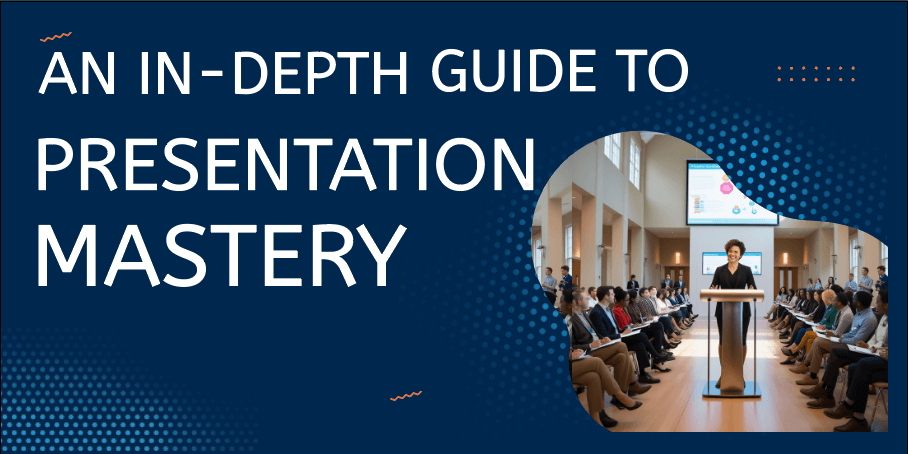
Who wouldn’t desire a standing ovation at the end of their speech? Not a single presenter we know of.
A room full of people applauding for the impactful presentation or a few nods here and there for the effort and the information.
The choice is clear for all who stand in front of the podium. But it’s not something each of us gets to achieve.
Why?
A lot goes into making an excellent presentation- from relevant data and impactful designs to compelling narratives and great delivery. There are many ingredients; each must be in the apt ratio to get the concoction right.
This article is a guide towards presentation mastery. Read on, and you will find everything you need to know to create a perfect piece that aligns well with the most critical aspect of your presentation- your audience.
A Detailed Guide to Presentation Mastery
1. Planning the Presentation
- Present with a Purpose
You can coach yourself in every aspect of speech delivery to refine it as much as possible.
But if you don’t have a convincing theme or message for the presentation, there’s no way it can lead to a good delivery even if you ace at everything else. Find the objective of your message.
- Learn About People
If you draft your message as a journey, the biggest task would be to figure out where to start and end. The right place to start would be knowing how much the audience is aware of your topic.
Not understanding their knowledge, interest level, and inclination, as well as including too many technical terms, can be detrimental to your presentation and make people lose interest.
The most engaging presentations are those where speakers quickly introduce the topic, let people know why they care so deeply about it and convince them to take the desired action.
So, know the audience and have clear goals for drafting a precise outline for your presentation.
2. Content of the Presentation
a). Visuals and Multimedia
Your presentation shouldn’t be constricted to words. Choose the best type of visuals that complement and highlight the core message of your presentation and make a strong impact on people. Multimedia can be very effective if used well.
However, be mindful of things like:
- Your video clip needs to be shorter than 60 seconds, or you might risk losing the audience’s attention. Also, they shouldn’t have a soundtrack.
- Don’t incorporate infomercials or self-promotional videos.
- Add charts, graphs, illustrations, infographics, etc., with clear labels to make your content more inclusive and digestible.
- Remember to include HD images to reduce the risk of pixelation on different screen sizes.
- Animations and transitions are effective when not overdone.
b). Effective Use of Presentation Software and Tools
Presentation software will optimize the use of technology to get the right slide design that enhances your speech.
You can also try ready-made editable templates to create professional, crisp, and visually cohesive presentations.
c). Include Data, References, and Sources
No presentation is complete without credible data and statistics. Even when you feel you are a prominent authority in your field, it would be wise to include referenceable material to substantiate it.
d). Frame Your Message
No way you can deliver a great presentation if you don’t have something worth sharing. Conceptualizing and framing your message appropriately is the most crucial aspect of delivering a presentation, as it will help you formulate your words correctly.
The reasons for a talk to fail are almost always around the speaker’s inability to frame the message correctly, misjudging the interest of the audience, or neglecting the power of a good story.
3. Delivering the Presentation
(i). Icebreaker
Try to include icebreaker activities in your presentation to get people comfortable with each other. It will ease the initial hesitation and smoothen out friction, if any.
Once you have the audience relaxed, and in a positive setting, it will be easy to include them in your talk.
(ii). Vocal Variety
Practice vocal variety to enhance your speech. Also, you might want to come across as authoritative, passionate, wise, strong, etc., through your tone, but it’s best to sound conversational.
Don’t try to become what you are not by forcing yourself to a certain style of speech. The audience might see it through and shut down in response. Speak clearly and professionally. Also, be mindful of your pace, pitch, tone, etc., to deliver effectively.
(iii). Stage Presence
Beware of your intentional and unintentional body language and gestures when speaking publicly. Your nonverbal communication is as crucial as spoken words, so practice and refine both to deliver an effective speech.
For inexperienced speakers, physically standing on the stage might seem like a lot. The result is too much body movement (swaying) or shifting weights from one leg to another. It can make the speaker seem nervous and also distract the audience.
Few tips:
- Keeping your lower body motionless can significantly better your stage presence. If walking around the stage comes naturally, you can do that too, but you would be better off standing still and moving your upper body (hands) for emphasis.
- Also, remember to make eye contact. Look for 5-6 friendly faces in different parts of the crowd, and make eye contact with them as you speak. Eye contact is immensely powerful, and it will create a big difference in your speech delivery.
(iv). Tackling Nervousness
Nervousness is not a disaster but something that keeps you sharp. Remember, authentic vulnerability helps connect with people and create engagement.
You can try different ways to tackle nervousness (pre-presentation and on-stage) like:
- Power poses, standing firm and tall, etc., can make you feel confident and help you deliver a more confident speech.
- Deep breathing and meditation.
- Visualize success.
(v). Evaluation and Feedback
Self-assessment and then course correction are crucial elements in any mastery. As a presenter, you should evaluate and refine yourself constantly to become a better speaker.
Seek feedback from experts (seasoned presenters) to polish your work and become a more persuasive speaker.
(vi). Increasing Knowledge and Building Skills
It’s important to constantly upgrade your knowledge base and skills to walk the path towards presentation mastery. You should have complete knowledge about your topic and be upgraded with recent technologies to design your slides in the best possible way.
Also, being thorough with the topic will position you as a credible and trustworthy person in your field and let people listen to you better.
(vii). Managing a Difficult Audience
As a presenter, you often face disruptions from the audience. For instance, general chatterers (people who like to talk), interrupters (constantly speaking when someone’s talking), arguers (who think they are more knowledgeable and know better), etc.
It is wise to practice for different types of potential disruptions to be comfortable in every scenario and address every uncomfortable situation in a calm and professional way.
- You could work on strategies to keep the interrupter at bay, like giving them a task.
- Also, address your audience at the start and let them know you will answer their questions at the end.
(viii). Highlight Your Area of Expertise
Be it professional or academic, remember to include a small section in the presentation regarding your life experiences. One major benefit you would get out of it is personal branding.
Knowing about the audience will help you market yourself more professionally and network with other speakers and potential clients.
(ix). Take the Help of Digital Media
You can build a social media presence around your presentation to connect to more people. Take the help of different types of online communication to engage people on a personal level or with your company. Post content before and after your presentation to pique curiosity and awareness.
Try writing a blog to engage readership. You can also share quotes or snippets from your presentation to keep people hooked.
(x). Your Communication Style
Figure out your preferred communication style and how it impacts your interaction with others. Learn about the different styles and identify yours using questionnaires.
(xi). Connecting Through Storytelling
Stories have the power to make speeches relatable and interesting. Weave your data and information in a story to help people remember. But remember to balance it right.
Meaning?
Most presentations lie in a continuum between data and a story. Statistics and data are rich with information and exhaustive but lack engagement per se. Stories are engaging but not laden with facts and information.
Pair your data and stories together rightly to deliver an impactful presentation.
(xii). Build Connection With People
Network with people. Draft your speech to inspire people. No one wants to listen to a talk that constantly boasts about how great the organization or the person is. It eventually becomes boring, and people might lose interest. Instead, focus on sharing ideas, stories, and solutions to problems.
(xiii). Keep it Succinct
If you try to include a lot of information, it will eat away the space of key details, and the talk will become abstract.
People who are aware of your topic might make some sense out of it, but to new listeners, it can sound completely opaque. Aim for specific examples and information to chalk out the ideas into coherent and concrete information.
Delve deeper into the topic, explaining your unique contribution to genuinely get people interested in listening to you.
(xiv). Active Listening
The audience should feel heard and cared for if you seek to build lasting connections. Demonstrate your ability to actively listen to what people have to say, and people will be interested in you and your message, as respect and understanding are mutual.
Allocate a dedicated time for the Q&A session to let people raise their queries in a calm manner.
(xv). Actual Delivery
There are 3 ways to deliver a talk – reading from a teleprompter, taking the help of notes/bullet points, and memorizing the talk verbatim through enough rehearsals.
The first option is a big no, as people can instantly lose interest in your words if they know you are reading a script.
The best talks are the ones people learn through rehearsals to come out naturally like a conversation and keep people engaged. That being said, if you don’t have enough time to rehearse your speech enough times, it’s better to go for bullet points on note cards.
(xvi). Practicing
The wise thing to do is to start practicing 6 months or before the main event. That way, you will have plenty of time to get it right and be in the final form at least a month before the event.
The more you practice in the final weeks, the better off you will be towards a perfect delivery.
When choosing to present in front of an audience (practice sessions), be mindful of the lot, as people might have varying/conflicting suggestions, which can be confusing. The better option is to rehearse in front of seasoned presenters, as they can offer better insights.
Few Mistakes that Can Ruin a Presentation
Here are some common mistakes that could blow your presentation and should, therefore, be avoided.
- Explaining, for long, what the speech is about.
- Being dramatic and overemphasizing with your words to create an effect.
- Subtly throwing hints of how important you or your organization are.
- Referring to your work or quoting from it.
- Overburdening your slides with unnecessary text and designs.
- Overuse of technical words and data to sound smart.
- Not rehearsing enough to adhere to the time limit.
- Not using eye contact or nonverbal communication effectively.
- Sounding robotic, as if reciting words from memory.
In a Nutshell
In today’s fast-paced digital era, presentations are not just about showcasing data; they are more about storytelling, striking visuals, interactive elements, and conversational tone. Presentations are compelling narratives, weaved with relevant data and insights to steer people in the direction that drives results.
Whether you are a student, educator, or a business professional, you need to deliver a presentation at some point in time. For this, you must master presentation skills if you truly want to resonate with the audience and get your message heard and remembered well.
We hope this guide helps you overcome your fears and equip you with the skills to succeed in every presentation gig.