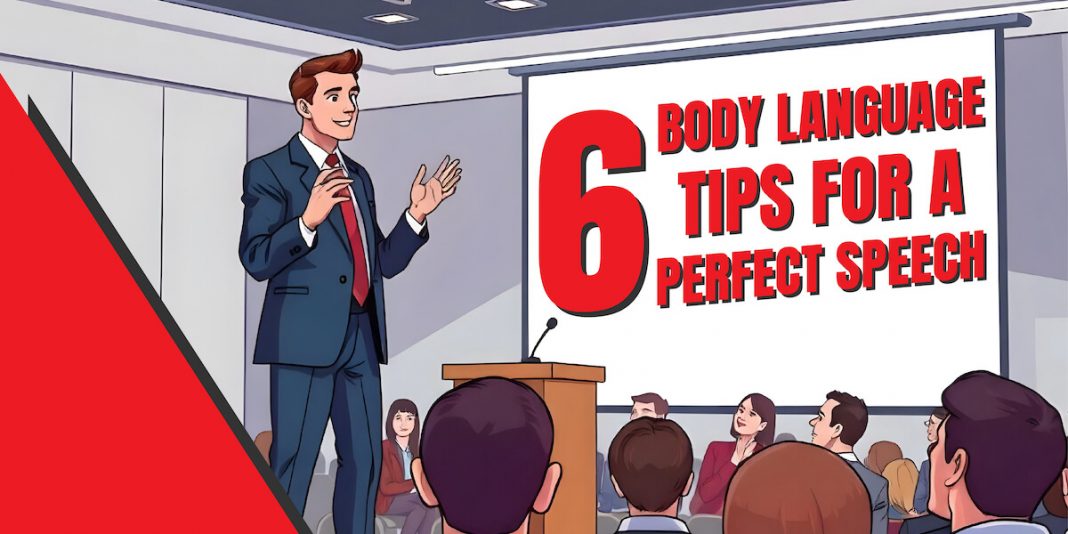
Imagine attending a speech, and as soon as the speaker steps up the stage, you find them fidgeting. Their posture seems abrupt, and their expressions do not match their words. They constantly keep looking here and there and maintain no eye contact. Would you not feel disappointed and distracted? Of course, you would.
Thus, the importance of good body language can’t be overlooked. In a world with fleeting attention spans, body language acts as an anchor to the audience’s attention.
In this article, we have covered the following-
- A Look at Numbers: Body Language and Key Statistics
- What is Good Body Language on Stage
- Tips to Improve Your Body Language During a Speech
A Look at Numbers: Body Language and Key Statistics
Body language is the silent force that creates an impact before a speaker begins. Let us look at some numbers to understand this further.
- 90% of communication is nonverbal (source).
- Non-verbal cues can help speakers project ten times more confidence and build and maintain connections (source).
- Communication is 55% non-verbal, 38% vocal (voice modulation, tone, etc.), and only 7% words (source).
What is Good Body Language on Stage?
(i). Eye Contact
Eye contact helps maintain engagement during the speech. When speakers gaze into the audience’s eyes softly, they communicate their interest and create a non-verbal bridge between them and the audience.
However, too much eye contact can seem inappropriate and intimidating and turn tables against you. Thus, remember to strike a balance.
(ii). Gestures
Gestures refer to the body movements during a speech. It includes movement of one’s arms, head, etc. These can command attention and elevate your impact as a speaker.
For instance, hand movements can be used to highlight certain points, illustrate concepts, and even direct attention. Head nods can be appropriate while listening to audience questions.
(iii). Body Posture
Posture is the backbone of good body language. It includes standing tall with your shoulders rolled back, having adequate distance between the feet, keeping your spine lengthened, etc.
When your posture is incorrect, such as slashing or crossing your arms, it can make you seem unprepared and defensive and create a negative image.
(iv). Facial Expressions
Your expressions speak louder than words. While delivering a speech, focus on your facial movement. Let us understand with an example.
Consider you are delivering a speech on climate change. When you state facts, keep a straight face and have firm and stern expressions for bold and concerning statements, and to display impact and effects, have a mellow or sad face to showcase the gravity of the situation.
Such a variety of expressions increase the impact of the oral word and communicate emotions in a more effective manner.
Tips to Improve Your Body Language During a Speech
1. Cover the Stage
Moving across the stage can add dynamism to your performance and make you more participative. When you stand in one place, it can create monotony and make your speech seem unappealing. However, when you move, even the audience feels included and involved.
Remember, do not move around purposelessly. Keep your movement mindful and thoughtful.
2. Leadership Gaze
The leadership gaze involves maintaining steady, confident eye contact with your audience to project authority. Making eye contact with different individuals or sections of the room is important rather than just staring at one spot.
This trick makes each person feel personally attended and creates an emotional connection. It also shows your command and attentiveness.
3. Match Gestures to Your Words
Your gestures and words should always be in coordination, as gestures are supposed to enhance your words and give more meaning to them.
For instance, during a sales speech, you can use a simple hand gesture that shows rise to explain the increase in numbers and data. It adds more value to your words and makes them impactful.
4. Smile and Mean It
Smile is one facial expression that can make a huge difference in your speech. When you smile, you make yourself more approachable and display a sense of being understanding and appreciative. It also reflects a softer tone, making your speech more friendly and welcoming.
5. Practice, Practice, Practice
The most effective way to improve your body language is through consistent practice. Rehearsing your speech in front of a mirror or recording it allows you to observe your posture, gestures, and facial expressions. Practice helps you become more aware of your body language, enabling you to adjust and perfect it.
Repetition also builds muscle memory, so when you’re delivering your speech in front of an audience, your body language flows naturally without requiring too much conscious effort. The more comfortable you are with your movements, the more confident and engaging you will be on stage.
6. Harness the Power of AI
AI can be a potent tool to help improve your body language during speeches. Platforms using AI technology can analyze your presentations, offering insights into your posture, gestures, and eye contact. They can identify areas where you may seem tense or lacking energy, providing actionable feedback for improvement. AI tools can also simulate audience reactions, helping you practice your speech delivery in realistic settings. Additionally, AI can assist in refining your speech content to align with your body language.
Incorporating AI feedback into your practice sessions can help you optimize your stage presence and become a more confident, engaging speaker.
Conclusion
If you are a speaker, good body language is essential to build credibility and establish yourself as an industry expert. It can also allow you to become more confident in your act, boost your self-esteem, and perform better.