For centuries, great speeches have shaped history, inspired movements, and changed the course of societies. From Martin Luther King Jr.’s “I Have a Dream” to Steve Jobs’ Stanford Commencement Address, powerful public speaking has always relied on a combination of charisma, storytelling, and human connection.
But in today’s fast-changing digital world, public speaking is no longer just about standing on a stage with a microphone. Technology is rewriting the rules of communication. Artificial intelligence (AI), virtual reality (VR), augmented reality (AR), and data analytics are transforming the way speakers prepare, deliver, and engage with their audiences.
The future of public speaking lies not in replacing human presence with machines, but in blending timeless human skills with powerful technology. This partnership will create speeches that are more impactful, personalized, and globally accessible than ever before.
1. Human Skills That Will Always Matter
No matter how advanced technology becomes, certain human qualities will always form the foundation of effective public speaking:
- Confidence and Presence: The ability to command attention through posture, tone, and energy is irreplaceable.
- Storytelling and Empathy: Data informs, but stories move hearts. Human empathy helps tailor messages to resonate with audiences.
- Body Language and Voice Control: A raised eyebrow, a pause, or a powerful shift in tone often says more than slides or numbers.
- Adaptability: Skilled speakers sense when the audience is losing focus and adjust their approach instantly.
Technology can amplify these qualities, but it cannot substitute the authenticity and human warmth that audiences crave.
2. AI as Your Speechwriting & Rehearsal Partner
Traditionally, preparing for a speech meant hours of drafting, rehearsing, and revising. AI is changing that.
Modern AI tools can generate first drafts of speeches customized for specific audiences—investors, students, or conference attendees. They analyze language tone, suggest stronger phrasing, and even insert relevant quotes or statistics.
But the real magic lies in rehearsal. AI-powered apps like Yoodli or Orai record your practice sessions and provide instant feedback:
- Did you use too many filler words like “um” or “you know”?
- Was your pace too fast or too slow?
- Did your tone convey confidence or hesitation?
These tools act as virtual coaches, helping speakers polish their delivery before facing a live audience.
3. Immersive Speaking Experiences with VR, AR, and Holograms
For many, the scariest part of public speaking is standing in front of a crowd. VR is changing that by letting speakers rehearse in lifelike virtual environments. Imagine practicing in a simulated TED Talk setting or in front of a packed boardroom—all from your living room.
AR, on the other hand, provides real-time prompts and cues. A speaker could glance at invisible notes projected onto their field of vision without breaking eye contact with the audience.
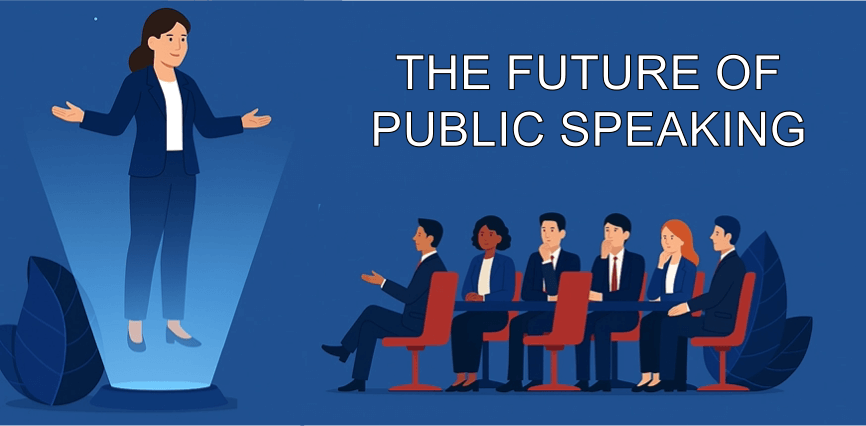
And then there are holograms. Leaders can already beam themselves into conferences on the other side of the world. In the near future, hybrid events may feature a speaker addressing half the audience in person and the other half as a holographic projection. The possibilities for global reach are unprecedented.
4. Micro-Content: Snackable Speeches for Short Attention Spans
We live in an age of shrinking attention spans. Research shows that most listeners lose focus after 10–15 minutes. That’s why the speeches of the future will need to be shorter, sharper, and more engaging.
Instead of hour-long lectures, speakers will deliver snackable speeches – high-impact talks under 5 minutes. AI will help repurpose longer speeches into bite-sized clips for platforms like LinkedIn, Instagram, or TikTok.
This means a single keynote can live multiple lives: a complete recording for YouTube, highlight reels for social media, and 30-second inspirational snippets for busy professionals.
5. Data-Driven Delivery and Audience Analytics
One of the most exciting developments in public speaking is the rise of real-time audience analytics.
AI tools can now track facial expressions, body language, and even emotional responses in real time. Imagine knowing whether your joke landed, if your audience is losing interest, or which slide made them lean forward.
Data-driven delivery allows speakers to:
- Adjust their pacing mid-speech.
- Add an interactive poll to re-engage distracted listeners.
- Compare performance across multiple talks.
After the speech, analytics provide a detailed breakdown: What worked well? What fell flat? This feedback loop allows speakers to improve continuously, just like athletes reviewing game footage.
6. Upskilling Speakers in the Tech Era
The speakers of tomorrow will need more than just traditional communication skills—they’ll need to be digitally fluent.
- Learning how to use AI as a co-writer.
- Practicing in VR environments for confidence building.
- Understanding data dashboards to interpret audience feedback.
Forward-thinking organizations are already including public speaking tech training as part of their leadership development programs. Just as PowerPoint once became a standard skill, AI-assisted speaking tools will soon be the norm.
7. The Perfect Blend: Human + Technology
So, what does the perfect speaker of the future look like? It’s not someone who lets AI do all the work, nor someone who ignores technology altogether. It’s someone who blends both.
- Human warmth and charisma capture attention.
- Technology-powered insights fine-tune the message.
- Immersive tools expand reach across geographies.
The best public speakers will act as storytellers first, technologists second – using digital tools not as crutches, but as amplifiers of their natural strengths.
8. The Road Ahead
Looking forward, public speaking will become more inclusive, immersive, and personalized.
- A young entrepreneur in India could pitch investors in New York via hologram.
- A student nervous about their first speech could practice in a VR auditorium until confident.
- A CEO could receive real-time AI cues, reminding them to slow down or smile more.
Most importantly, technology will make public speaking more accessible to everyone, not just seasoned professionals. Anyone with an internet connection and a willingness to learn will be able to improve their skills with AI as their coach.
Conclusion
The art of public speaking is not dying—it’s evolving. The future is about combining human authenticity with digital augmentation. Technology can help us write better, rehearse smarter, deliver with precision, and connect with audiences across the globe.
But at its core, public speaking will always be about human connection. The best technology in the world cannot replace the power of a heartfelt story, an empathetic tone, or an authentic smile.
The speakers who thrive in the years ahead will be those who embrace both worlds – human skill and technological innovation – blended seamlessly to inspire, educate, and move audiences everywhere.