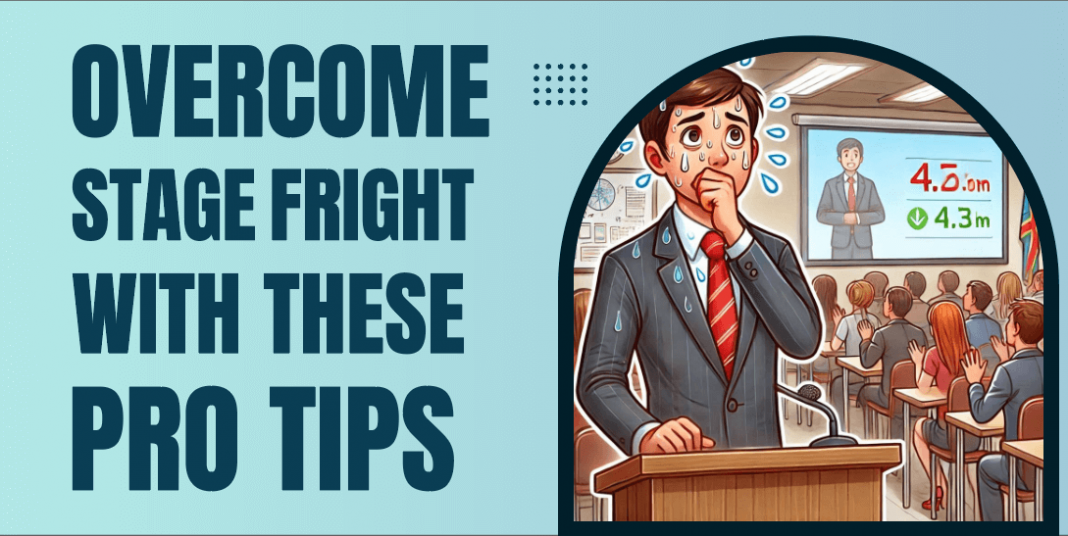
The event manager raises their head to call you on the stage. You are next in line to speak at the conference. You nod back to signal you are ready, but in actuality, you are extremely nervous.
Just a few moments ago, you were enjoying others speaking up and confidently replaying your speech in your head. Now, that has given way to fast breathing, a pumped-up heartbeat, a churning stomach, and sweaty palms.
No matter how your body chooses to react, the symptoms mentioned above are stage fright, aka performance anxiety. Before moving further, let’s find out what it means.
What is Stage Fright?
Stage fright is anxiety you feel in front of an audience before or during the speech. Like most anxieties, it makes you mistakenly think you are in danger.
As a result, the human body – conditioned through evolution – wants to flee, fight, or freeze, which can come in the way of anything, including your performance.
Causes of Stage Fright
Stage fright is often connected to issues like –
- Deeper fears of being seen/heard by other people (center of attention or the spotlight effect)
- The thought that you are less than others/not perfect – social anxiety and low self-esteem
- Impostor syndrome
- Inadequate preparation
- Insufficient experience
- Psychological reasons, including fear of failure, judgment, rejection, mistakes, etc.
- Already suffering from anxiety issues
- High stakes – a significant event
Consequences of Stage Fright
Stage fright can manifest itself in the following ways-
- Physical Symptoms: Trembling body, dry mouth, tight throat, rapid heart rate, narrowed vision, nausea, cold extremities, etc.
- Mental Symptoms: Mental distraction causes people to forget lines, lose their chain of thought, or articulate ideas improperly.
- Impaired Communication: Sabotaging effective communication leads to low impact and receptivity of the message.
- Low Self-Confidence: The fear of stepping on the stage can hinder professional and personal growth.
Tips to Overcome Stage Fright
Public speaking/stage fright tops the chart with other general phobias, such as fear of flying, spiders, snakes, or even death. This fear significantly affects people’s confidence and esteem, sometimes letting them miss significant opportunities.
If this sounds like your story, fear not. Follow our expert tips to overcome stage fright and deliver gracefully and impactfully.
Before the Speech:
1. Set a Time Limit
Train your mind to feel nervous for a certain amount of time. You can set a timer and let yourself go through the feelings. After that, engage in physical activities, speak to someone, or watch something funny to keep yourself engaged and not think about it any longer.
When you train your mind to compartmentalize like that, it will help you quickly shift focus on the day of performance, switching off unpleasant thoughts and working towards performance.
2. Develop a Routine with Relaxation Techniques
Set a daily routine, incorporating activities that calm you down, redirect your negative thoughts, and take you forward. For instance, you can try the following methods.
- Creative Visualization – Each time you think of your speech or any other ideal scenario, create a positive mental image of you performing successfully, with a standing ovation. Try to shift your thoughts from everything that can go wrong to calm and reassuring thoughts and pictures. Your focus should be on your strengths and capabilities to handle challenging situations.
- Positive Statements – Use positive affirmations and statements like “I can do it,” “I have got this,” “I am competent,” etc., to set a positive mindset. Get rid of thoughts that cause self-doubt and low confidence.
- Meditation and Mindfulness – Meditate sometime each day to calm your nerves and concentrate your mind. It will help you focus and direct your energies towards a better outcome. Regular meditation will also aid you in ignoring immediate negative thoughts and accessing a wiser version of yourself.
- Biofeedback – Use the technique to control and manage stress and anxiety and relax.
- Controlled Breathing – Regulate breathing to help calm your nerves and lower your heart rate. When you are anxious, your breathing automatically becomes short and quick. By deliberately breathing slowly, you will convince your body that you aren’t in danger. Do rhythmic breathing, where the exhalation is twice as long as the inhalation, as it naturally soothes the nervous system.
- Relaxation Exercises – Do relaxation exercises like yoga that relax your mind and body.
- Progressive Muscle Relaxation – The method involves tensing and relaxing different muscle groups, resulting in improved muscle relaxation. You can find a quiet place, do some deep breathing, and then start clenching and releasing your muscles, beginning from your toes and working your way up. The technique will help diminish muscle tension related to anxiety, promoting stage fright management.
- Posture – Fix your posture – sit/stand calmly, confidently, and self-assuredly. Keep your shoulders firm and erect, stand up straight, open your arms, and lengthen your neck. You can also try power poses to feel and exude confidence.
- Workout – If working out is normal for you, don’t skip it on the day of your performance as well. You need the endorphins (they counteract the feeling of anxiety), so go for a run, get to the gym, or take a dance class – whatever works best. Exercising is a great anxiety-management tool. It will take away all the unwanted energy, leaving you with happy hormones and a calmer mind.
3. Thoroughly Prepare
Do you remember feeling nervous in a classroom when asked a question? It was because we were not prepared and didn’t know the answer. When you knew, do you recall how confident and comfortable you were in being asked and answering?
Go through your slides at least twice before stepping on the stage. Get acquainted with the venue and technology.
Thorough research and preparation will greatly manage your stage fright because you will be comfortable with the material and will feel natural speaking about it. You will also be more comfortable addressing the audience’s queries and managing unpredictable technical glitches.
4. Be Yourself and Find Acceptance for Your Fear
One primary reason for stage fright is putting unnecessary pressure on oneself by seeking perfection.
Improving your performance skills would be good but not enough to get you out of your anxiety. You must look deeper, analyze, and address the negative perceptions, beliefs, thoughts, and images related to public speaking.
Normalize yourself because it’s okay to make mistakes, and be yourself. When you receive that acceptance, you will be more comfortable in your skin, playing to your strengths and delivering with confidence.
It will automatically let you tackle your nerves more smoothly.
5. Practice Well
Practice as much as possible in front of family, friends, colleagues, mentors, etc. It will help you refine and polish your content and delivery. With enough practice, you will know the content like the back of your hand.
Repetition allows the activity to sink into your body so you can still recall and perform even when your brain feels frozen. If you have difficulty finding an in-person audience, get the help of a live video.
6. Rely on Pauses
When you practice, incorporate short pauses in your speech. Train your mind to rely on a pause in case you lose your chain of thought. Let people have that space to internalize your words and take in all the knowledge.
How it will benefit you is – in case you get nervous, it will give you the time and space to recollect your thoughts and move forward. And the best part – nobody will realize anything. Knowing you have something to rely on during the speech without losing face will help alleviate performance anxiety.
7. Cognitive Behavioural Therapy
The technique is a structured therapeutic approach that helps people systematically and comprehensively deal with negative thought patterns associated with stage fright.
This therapy identifies and challenges negative thoughts, replaces them with something positive, conducts behavioral experimentation to determine the validity of your negative thoughts, develops coping strategies, and then gradually exposes you to low-pressure environments.
8. Systematic Desensitisation
The therapeutic technique allows for exposure from the feared situation in a controlled, calm, and systematic way while making use of relaxation techniques to keep the anxiety at bay.
What you can do is create a fear hierarchy (a list of situations that trigger different levels of anxiety), learn relaxation techniques, initially expose yourself to low-anxiety and then eventually high-anxiety situations, monitor and adjust, and celebrate all successes, no matter how small, as you walk through your fear hierarchy.
9. Take Help from a Professional
If you feel that your stage fright is particularly severe, it is best to consult a professional. Talk to your mentor, family, friends, or whoever you feel is in a position to help you manage your anxiety.
They can share personal stories, anecdotes, and tips to help you alleviate your anxiety and tackle it better.
10. Do it as Much as Possible
Leverage every opportunity to talk in front of people. The more you do it, the less frightening it will become eventually. There will be normalcy regarding speaking in front of people, which will reflect in every eventual public speaking.
On the Day of the Performance:
(i). Shift Your Focus
There is a reason you have chosen to stand on that stage. You want to share something of value with people. Shift your focus from yourself and your anxiety to the true purpose of your speech. It will motivate you to overcome your fears and deliver what you wish to say.
Also, rationalize the situation in your head. It’s not life or death, even if you fumble in the presentation. It’s OK to be nervous, and your audience knows it too.
(ii). Get Rid of the Excess Adrenaline
Anxiety fills your body with adrenaline. Get rid of it before the speech to feel calm and in balance. Shake your body, jump up and down, walk around, shake your limbs, and so on.
Try to move around as much as you can to eliminate excess energy and keep your mind and body peaceful.
Note – Avoid caffeine and other stimulants, as you don’t want to charge yourself even more with that rush of adrenaline. Go for herbal tea and switch to a latte later.
(iii). Build a Connection with People
People sitting in the audience don’t want you to fail. They expect you to be nervous, so embrace your vulnerability. It will help you form a genuine and humane connection with your audience.
Smile at them and greet people warmly. Remember to make eye contact when you speak. Good body language will help you feel more comfortable with the audience members, keeping your nerves at bay.
Also, learn as much about your audience as you can. Go through their social media profiles and learn about their concerns and inclinations. The familiarity will help you eliminate the discomfort of speaking to strangers.
(iv). Project Confidence
Don’t run around telling people how scared and nervous you are. The feeling of nervousness will consume you more and transfer your energy to other people as well.
Instead, project confidence and believe you will have a captivated audience tonight. Deliberately projecting such energy will convince your mind to believe the words and follow the same thoughts.
Pro Tip – Rely on your warm-up routine right before your speech. A familiar ritual before your performance will remind you of all the efforts you have put in to come this far. Also, dress for success.
(v). Turn the Spotlight on People
Stage fright is intimidating because it feels like all eyes are on you. People are watching your every step, word, and move. And if you make one small mistake, maybe people won’t perceive you as efficient.
The spotlight is scary.
Turn that spotlight around in your head – to your audience. The reason you stand there is to illuminate your listeners regarding something. They are the ones who seek something out of you.
Final Thoughts
A little bit of anxiety is good. If you can channel that vulnerability and adrenaline into your performance, it can make you feel better and help you connect with people on a deeper level.
If it still feels undoable, we hope you embark on the journey to conquer or manage stage fright with our actionable tips and strategies.